
Spirulina Farming Business in India: Investment, Production and Earnings
Spirulina farming business is a sector that offers a unique opportunity to Indian agripreneurs. There is a spirulina product market thanks to the growing interest in natural health supplements and protein-rich foods, feed additives for livestock, and wellness products.
Spirulina is a blue-green microalgae that is praised as a “superfood.” It is rich in many nutrients. The consuming public is more health-conscious. Thus, the market for high-quality Spirulina is growing.
In this guide, the aspiring farmer, agripreneur, business ideas startup founder, and the businessman with an interest in the health industry will find the investment, production, costs, income, and business opportunities of spirulina farming.
What is Spirulina?
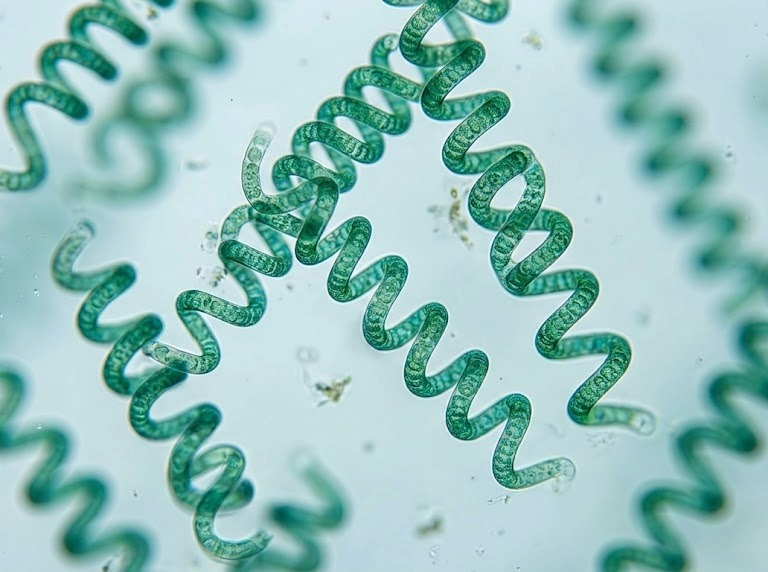
Spirulina is blue-green micro algae that can be found in the alkaline waters of the world. It is commercially cultivated because of its excellent nutrition.
Nutritional Value of Spirulina
Spirulina consists of:
- 55% to 70% protein
- Iron
- Calcium
- Magnesium
- Vitamin B complex
- Beta-carotene
- Chlorophyll
- Antioxidants
For all of its nutritional reasons, Spirulina is also found in the following:
- Health supplements
- Nutraceuticals
- Functional foods
- Animal feed
- Aquaculture
- Cosmetics
Why Start a Spirulina Farming Business?
There are many reasons to prefer the farming of Spirulina over even the farming of other forms of algae.
High Market Demand
There is an increasing demand in the markets around the world and in our own local markets.
Small Land Requirement
A smaller footprint is possible to farm Spirulina.
Sustainable Production
Land and water usage is further minimized.
High Value Product
A higher markup is possible on processed Spirulina.
Multiple Revenue Streams
The following products can be sold:
- Spirulina powder
- Spirulina tablets
- Capsules
- Animal feed supplements
- Cosmetic ingredients
Market Potential of Spirulina in India
India’s rapidly growing health and wellness industry has a promising market for Spirulina.
Increasing Health Awareness
People are focusing more on preventive health care and good nutrition.
Growth of the Fitness Industry
Spirulina is a great natural protein supplement for many fitness-focused people and athletes.
Vegan and Vegetarian Nutrition
Spirulina has all the nutrients and protein a plant-based diet lacks.
Export Opportunities
Spirulina is in demand all over the world for the health and food sectors.
With more awareness of its benefits, spirulina farming will be a viable niche agricultural business for many.
Requirements for Spirulina Cultivation
There are a few basic things that need to be understood before starting production.
Warm Climate
Spirulina prefers a warmer climate of between 30°C and 38°C and needs a good deal of sunlight.
Water
Water is essential for cultivation.
Alkaline Environment
Spirulina thrives in highly alkaline environments, which also prevents the growth of most microorganisms.
Spirulina Farm Set up
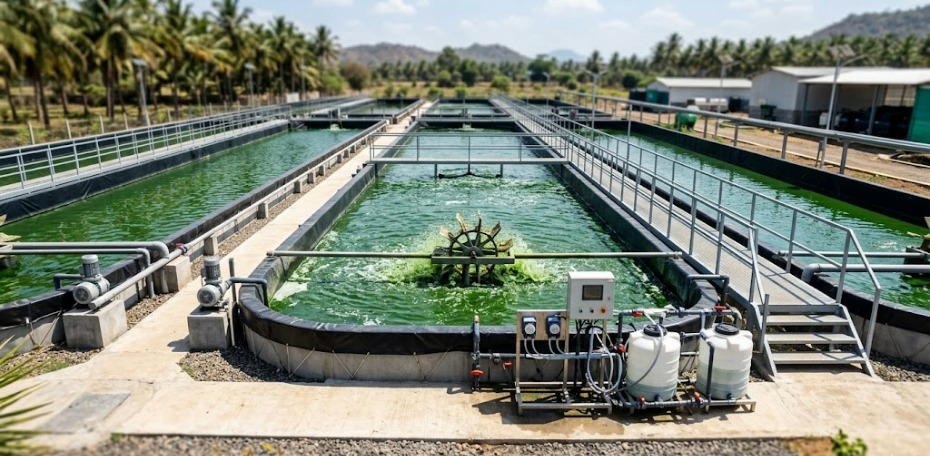
A spirulina production unit consists of cultivation tanks or ponds.
Tank Construction
Examples of tank construction materials include:
- tanks made of cement
- tanks made of bricks
- HDPE-lined ponds
- Fiberglass tanks
Typical Tank Size
Depths of around 20-30 centimetres are most common for the tanks of small commercial units.
Sunlight can penetrate the tank more easily and can also improve management of the unit.
Aeration and Mixing
For Notable Growth
Mixing helps improve and cultivate nutrient growth and also helps maintain nutrient growth and prevents the Spirulina from settling in the tank.
Spirulina Cultivation Process
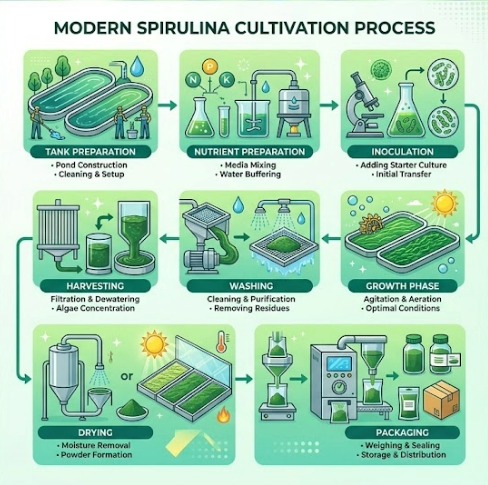
There are many steps in the Spirulina cultivation process.
Step 1: Tank Preparation
To begin the cultivation process, the tank must first be cleaned, then filled with water and adjusted to the desired alkaline conditions.
Step 2: Nutrient Medium Preparation
A nutrient medium is prepared that is rich in the essential nutrients needed for the growth of Spirulina.
Step 3: Inoculation
The tank is then prepared for algae growth by adding the Spirulina seed culture.
Step 4: Growth Phase
Spirulina proliferates very quickly if the appropriate conditions of temperature, light, and nutrients are all available and sustained.
Step 5: Harvesting
The Spirulina culture can then be harvested by filtering out the biomass and drawing off the water when the desired density has been achieved.
Harvesting can also be done as needed to meet production targets.
Step 6: Washing
To eliminate any remaining impurities, the Spirulina is washed.
Step 7: Drying
Spirulina is dried for preservation.
Drying is critical because it affects:
- Product quality
- Shelf life
- Nutritional value
Step 8: Packaging
The final product is packaged as:
- Powder
- Tablets
- Capsules
Ready for market distribution.
Cost of Spirulina Farming Business in India
The farming cost is scale-dependent.
Small Scale Spirulina Farm
Estimated Investment
| Item | Estimated Cost |
| Tank Construction | ₹30,000 – ₹60,000 |
| Starter Culture | ₹5,000 – ₹10,000 |
| Nutrients | ₹10,000 |
| Equipment | ₹15,000 |
| Miscellaneous | ₹10,000 |
Total cost
Estimated 60,000 – 1,00,000
Good for beginners and pilot projects.
Medium Commercial Unit
Estimated Investment
₹2 lakh to ₹5 lakh
Includes:
- Larger tanks
- Processing equipment
- Drying systems
- Packaging facilities
Large Commercial Operations
Scaled and automated commercial production may exceed 10 Lakh.
Spirulina Production Capacity
The production rate is dependent on:
- Tank size
- Culture quality
- Climate conditions
- Management practices
Well-managed systems can be harvested year-round, allowing year-round income compared to crops that are only harvested seasonally.
Spirulina Farming Business Profit

The main reason for starting this farming business is the profit.
Spirulina farming business can be profitable through:
- Bulk powder sales
- Retail packaging
- Health supplement manufacturing
- Export sales
- Contract production
Processed Spirulina itself isn’t as valuable as many other agricultural products, but the value is much greater compared to raw agricultural products.
Example Earnings Scenario
Small commercial unit:
Drying Spirulina and selling it can be a lucrative business depending on the:
- Market Price
- Quality of the Product
- Quality of Packaging and
- Distribution
The best profit margins are for value-added products.
How to Increase Spirulina Farm Profit

Prioritize Quality
Supreme quality usually leads to higher prices.
Value Addition
Instead of selling raw spirulina, consider:
- Powder packaging
- Tablet manufacturing
- Capsule production
are more profitable than raw Spirulina.
Create a Brand
Branding allows you to create trust with your customers and greater profits.
Farm to Consumer
Selling directly to the customer means you rely less on others for your sales.
Diversify Sales
- Sell to health stores,
- pharmacies,
- fitness centers,
- your own website,
- or sell to nutraceuticals.
Challenges in Spirulina Farming Business
As with all farming, there are hurdles in spirulina farming.
Water Quality
Affects growth and productivity.
Contamination
A less productive crop that is of lower quality is the result of contamination.
Climate Change
Unpredictable weather leads to less optimal growing conditions.
Develop a Market
Farmers need to create their own market as there is a lack of developed ones.
Marketing Opportunities for Spirulina
There are many markets to sell Spirulina to.
Health Supplements
This is a large area for demand and consumption.
Fitness
Athletes and gym goers support healthy nutrition.
Animal Feed
Spirulina enhances the nutrition of animal feed.
Cosmetics
Wellness and skincare products contain Spirulina.
Increased Demand
There is growing demand, and it is increasing internationally.
Future of Spirulina Farming in India

There is a lot of opportunity in this field with the growth of:
Rising Health Awareness
Consumers increasingly seek natural nutrition solutions.
Growing Wellness Industry
The demand for superfoods
Sustainable Agriculture Movement
Spirulina requires fewer natural resources than many conventional crops.
Export Expansion
Global demand creates opportunities for Indian producers.
These factors position spirulina farming as a high-potential agribusiness for the coming years.
Is Spirulina Farming Worth It?
For those who can learn cultivation and marketing skills, farming spirulina can be quite beneficial.
The advantages are as follows:
high-value products
increasing demand
large market
a model that can be easily replicated
a simple way to be sustainable
With the right management and marketing strategies, the cultivation of spirulina farming has the potential to be a beneficial long-term business.
Conclusion

For farmers and entrepreneurs wanting to participate in the health and wellness industry, the spirulina farming business in India has incredible opportunities. Spirulina farming has a strong demand and great profits with low land requirements. Because of this, it is being farmed more and more in India.
Farming spirulina successfully requires high-quality production, great marketing, and consistent improvements. Entrepreneurs can start farming on a small scale, and then as profits are generated, it can be expanded more.
Given the increase in demand for superfoods and nutritional supplements, starting a farm in India to cultivate Spirulina is a great answer to the unmet business opportunities in Indian agriculture.
Frequently Asked Questions
What is Spirulina farming?
Spirulina farming is the commercial cultivation of blue-green algae that are used in health-based supplements, food products, and even cosmetics and that are health-rich and used in animal feeds.
How much investment is needed to start spirulina farming business?
Small-scale spirulina farming can be started for an investment of INR 60, 000 to 100,000, depending on the infrastructure and equipment.
Is Spirulina farming business beneficial?
Definitely, considering the high-value product with an increasing demand in the domestic and international market.
What is the best temperature for Spirulina farming?
Spirulina prefers warm conditions, ideally between 30°C and 38°C.
What can be created from Spirulina?
There are many options for creating product derivatives from Spirulina, including powder, tablets, capsules, feed supplements, and even ingredients for cosmetics.